
It's All in the Feet
/Sometimes, our worst enemy in teaching can be the thought that we're above using devices that seem pretty elementary. When I was in drum corps (one of history's best brass lines, I might add), our caption head emphasized daily that the breath before we play was more than just a suggestion. He even went so far as to create a technique that helped the performers get the most amount of air as well as being used for timing to enter any given phrase. It was a simple, basic method that was so important to him that he repeated "Breathe–Dah!" in rehearsal more than our drum major called us to attention.
That's a key difference between Box Four and Box Five—application. Many instructors move on to intermediate and advanced material, and only occasionally reinforce the fundamentals. To see a great example we all deal with, go no farther than the students' feet. Basics block sets the foundation for pulse or beat but rarely gets into rhythm. That's where our biggest issues arise. Sure, we have to ensure that our students can march in time when we're isolating the beat. Once we have established that, what exercises can we use to demonstrate the use of the feet to maintain the pulse while simultaneously playing a rhythmic passage?
In 2005, while Program Coordinator of the Blue Stars Drum and Bugle Corps, there was a recurring melody that moved from section to section. The rhythm wasn't too complicated for musicians, but I noticed that every time a section would play it their feet would fall miserably out of sync. So, I stopped the horn line one day, put them on the 5 yard line, and had them march to the opposite end zone while singing the rhythm and marking time between repetitions. Rather than use the word "dah" or numbers, I had them sing the appropriate foot for each down-beat and the rest of the subdivisions as normal. By the time they got to the other side of the field they were feeling how the rhythms of the melody were overlayed on the driving pulse of their feet. Let's look at this example:
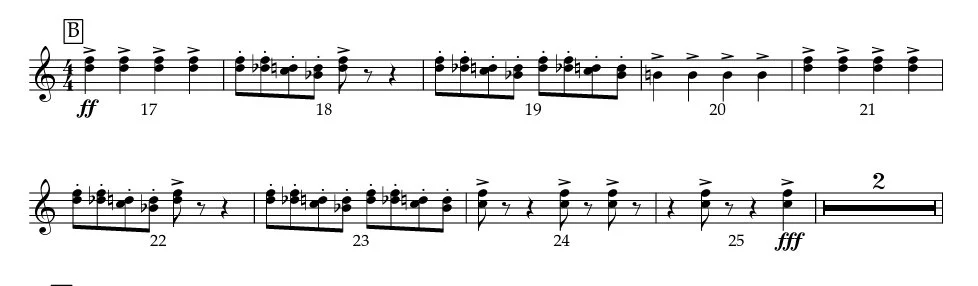
This excerpt is from Pee-Wee's Big Adventure, Breakfast Machine.
Left–Right–Left–Right! Left and right and left (breathe)! Left and right and left and right and, Left–Right–Left–Right! Left–Right–Left–Right! Left and right and left (breathe)! Left and right and left and right and, Left (breathe) Left–Right (breathe) Right (breathe) Right.
It's so simple. It's elementary. But it's so easily overlooked as a viable and useful tool. Whenever I have the opportunity, I encourage students to write their steps under their music so they can think of their feet whenever they look at their music. The next time you see one of your students marching out of time or on the wrong foot, maybe give this method a try. I'm sure your student will thank you.